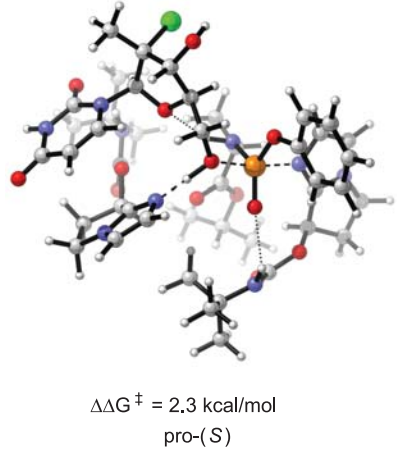
Transition state model of the second-order catalytic pathway. Credit: Science (2017). DOI: 10.1126/science.aam7936
(Phys.org)—A team of researchers with Merck & Co., Inc. has developed an efficient catalyst for producing pronucleotides, paving the way perhaps to a new class of drugs for combatting viruses and cancer. In their paper published in the journal Science, the team describes the experiments they conducted that led to identification of the components of the catalyst and how well it worked when used to create a hepatitis C virus inhibitor.
Nucleoside analogs have been used for several years to combat viruses and cancer—but making them requires developing a shepherd to carry them through protein membranes and then coming up with a way for activating them once inside—typically a three-stage process. Medical researchers believe pronucleotides offer a better solution. Prior research has shown that they are able to enter protein cells without assistance and can activate relatively easily and quickly once inside. They have also been shown to be less likely to be broken down by enzymes or to be expelled altogether from cells before they can do their work. Unfortunately, their use has been held up by the difficulty in creating large enough quantities for medical applications. In this new effort, the team at Merck describe a way to overcome that problem by introducing a new catalyst—one that can be used as part of an industrial process.
To create the catalyst, the researchers started with a promising dihydropyrroloimidazole framework recently developed by a team in Shanghai—using it as a base, they used computational modeling, kinetic analysis and informatics to modify the catalyst to suit their needs. The catalyst they developed featured the formation of chiral phosphorus centers in more efficient ways than others that had been tried—the problem had been the difficulty of inducing correct chirality, i.e. left or right handedness, in phosphorus. The catalyst was then used in combination with a nucleoside and a chlorophosphoramidate to create a pronucleotide drug called MK-3682 for use in treating hepatitis C—it tested so well that it is now in clinical trials.
The researchers also report that the technique they used for developing the catalyst could be used for other nucleoside analogs, allowing for the development of other drugs.
© 2017 Phys.org