By Anne Mullenniex Updated Mar 24, 2022
Quantitate your RNA sample by measuring its absorbance of ultraviolet light (UV). A nano-drop spectrophotometer will use only one or two microliters of your sample, which you can recover. Other spectrophotometers require a much larger sample. The extinction coefficient for nucleotides at a UV wavelength of 260nm in a 1-cm light path is 20. Based upon this extinction coefficient, the absorbance of 40µg/ml RNA under the same conditions is one. Using this information, you can compute the concentration of your RNA sample.
Make a dilution, if necessary, of your sample. A standard dilution for a microcuvette is 1:40. Make this dilution by adding 2µL RNA sample to 78µL sterile water.
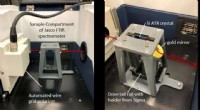
Follow the protocols of your particular spectrophotometer to calibrate the machine by using a blank and then determine the optical density of your sample at a UV wavelength of 260nm.
Multiply the absorbance of your sample by your dilution factor by 40μg RNA/mL . The equation would be: "RNA concentration (µg/ml) = (OD260) x (dilution factor) x (40µg RNA/ml)/(1 OD260 unit)" (Hofstra.edu) For example: If you diluted your sample by 1:40 and your absorbance reading was 0.08, you would multiply 0.08 x 40 x 40 = 128 µg/ml = 0.13 µg/μL
Figure out the purity of your sample by taking another absorbance reading at 280nm UV wavelength. The ratio OD 260/ OD 280 will indicate whether–and at what level–your sample is contaminated with protein or phenol. A result of 1.8 to 2.0 indicates quality RNA.
Don't forget to calibrate your Spectrophotometer. Running a quick electrophoretic gel will confirm your spec results.
Don't assume your sample is pure. Taking the time for an OD260/OD280 ratio saves time and money down the road.