Jupiterimages/Photos.com/Getty Images
Of the four fundamental forces—strong, weak, electromagnetic, and gravity—the strong nuclear force is the most powerful and is responsible for holding the atomic nucleus together. Its influence, however, is confined to an extremely short range, roughly the diameter of a typical nucleus.
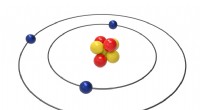
Every atom consists of a nucleus surrounded by electrons. Inside the nucleus, protons and neutrons are bound together by the strong force. While protons carry a positive charge, neutrons are electrically neutral. The strong force attracts both particles, keeping them together, but it decays rapidly outside the nucleus, so neighboring atoms do not feel its pull.
Protons repel each other through the electromagnetic force, which acts over long distances. Without another interaction to counteract this repulsion, protons would be forced apart. Neutrons, lacking charge, do not experience this repulsion. When a proton and a neutron come within about one trillionth of a millimeter (≈10⁻¹⁵ m), the strong force dominates and the particles bind together.
The modern understanding of the fundamental forces is that they arise from the exchange of force‑carrying particles. Massless photons mediate the electromagnetic force, allowing it to act over infinite distances. In contrast, the strong force is carried by massive pions, whose short Compton wavelength limits the range of the interaction to the femtometer scale.
In stellar cores, gravity compresses hydrogen and helium, generating pressures that bring protons and neutrons into close proximity. When they do, the strong force fuses them into heavier nuclei, releasing energy. Nuclear fusion yields about ten million times more energy per unit mass than chemical reactions such as burning coal or gasoline.
A neutron star is the dense remnant left after a massive star explodes as a supernova. Its entire mass is compressed into a volume only a few kilometers across, creating an object whose density rivals that of an atomic nucleus. A teaspoon of neutron‑star matter would weigh roughly ten million tons. Because the strong force dominates in this environment, all protons and neutrons are forced together, leaving no atoms in the traditional sense.
If the strong force were to act over macroscopic distances, the material on Earth would collapse into a compact sphere, roughly a few hundred meters across, with a mass equivalent to the planet.