Photo: iStock/GettyImages
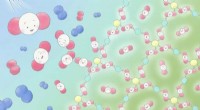
The defining feature of an acid is the behavior of its hydrogen atoms when dissolved in water. A strong acid releases most, if not all, of its hydrogen atoms as free protons, which immediately bind to water molecules to form hydronium ions (H₃O⁺). The remaining part of the acid molecule becomes the conjugate base, carrying a negative charge. The degree to which this dissociation occurs determines the acid’s strength.
Strong acids completely ionize, producing hydronium ions and leaving the conjugate base as a negative ion. Weak acids stay largely undissociated, with only a small fraction releasing protons. The balance between these species gives acids their characteristic behavior.
The most commonly encountered strong acids are hydrochloric acid (HCl) and sulfuric acid (H₂SO₄). In hydrochloric acid, the H–Cl bond is so weak that every hydrogen atom detaches when the acid dissolves. The liberated proton becomes a hydronium ion, while the chloride ion carries a –1 charge.
In sulfuric acid, both hydrogen atoms are similarly weakly bound. Upon dissolution, the two protons form two hydronium ions, and the remaining SO₄²⁻ unit carries a –2 charge. Because of this complete dissociation, both acids are highly effective at protonating other substances.
Strong bases behave in the opposite way: they release hydroxide ions (OH⁻) rather than protons. Sodium hydroxide (NaOH) and calcium hydroxide (Ca(OH)₂) are classic examples. Each molecule splits completely in water, giving a high concentration of OH⁻ that imparts basic character to the solution.
When a strong acid and a strong base meet, their ions pair off completely. The H⁺ from the acid combines with the OH⁻ from the base to form water, while the remaining ions assemble into a neutral salt. For instance, adding NaOH to HCl produces water and sodium chloride (NaCl), a stable, neutral salt. The completeness of ionization allows these reactions to proceed to completion under normal conditions.