By Jess Kroll Updated Mar 24, 2022
Atoms are the fundamental building blocks of life and everything else. Each atom contains a dense nucleus of protons and neutrons, surrounded by a cloud of electrons. Protons carry a positive charge, electrons a negative charge, and neutrons are electrically neutral. The atomic weight of an element is the sum of its protons and neutrons, while the atomic number—always the count of protons—identifies the element. Because the proton count never changes, the periodic table arranges elements by increasing atomic number, starting with hydrogen (1 p, 1 e) and extending to radium (88 p, 88 e).
A molecule is any group of two or more atoms bonded together to form a distinct chemical substance. Common examples include water (H₂O), carbon dioxide (CO₂), and dioxygen (O₂). The chemical formula indicates both the types of atoms involved and their relative numbers. Removing any atom from a molecule fundamentally alters its identity; a water molecule loses its properties if it loses an oxygen atom.
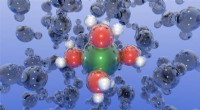
Atoms stay together through chemical bonds, the attraction between the positively charged nuclei and the negatively charged electrons. Bonds can be covalent—where electrons are shared—or ionic, where electrons are transferred. In water, the oxygen atom shares electrons with two hydrogen atoms, creating a polar molecule with a partial negative charge on oxygen and a partial positive charge on hydrogen, which underpins water’s unique characteristics.
Compounds arise when atoms of two or more different elements join in a fixed ratio. The diversity of possible compounds is essentially limitless, even though there are only 118 known elements. For instance, ethanol (C₂H₅OH) is an alcohol where a carbon atom is bonded to a hydroxyl group. The specific arrangement of atoms—rather than merely the elements present—determines a compound’s properties.
Some substances consist of a single element but in different molecular forms. Molecular oxygen (O₂) is essential for respiration, whereas ozone (O₃) protects the planet from ultraviolet radiation but can be harmful to living tissue. The number of atoms in the molecule changes its behavior and role in nature.