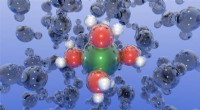
* Water (H₂O): Water molecules form strong hydrogen bonds, the strongest type of intermolecular force. These bonds are responsible for water's high boiling point, surface tension, and ability to dissolve many substances.
Let's look at the other options:
* Carbon Dioxide (CO₂): CO₂ is a linear molecule with only weak London dispersion forces, making it a gas at room temperature.
* Rubbing Alcohol (Isopropyl Alcohol): While rubbing alcohol has some hydrogen bonding, it's less extensive than water due to the presence of a nonpolar isopropyl group.
* Table Sugar (Sucrose): Table sugar has strong intermolecular forces, primarily hydrogen bonding and dipole-dipole interactions. However, these are distributed over a larger, more complex molecule than water.
* Gasoline: Gasoline is a mixture of hydrocarbons with very weak London dispersion forces.
Therefore, water has the strongest intermolecular forces per molecule at 25°C due to its extensive hydrogen bonding network.