* Size: Molecules are incredibly tiny, far smaller than the wavelength of visible light. To see something, light needs to bounce off it and enter your eye. But light waves just pass around molecules, they don't interact with them in a way that creates a visible image.
* Resolution: Microscopes work by focusing light to create an image. The resolution of a microscope (its ability to distinguish between two closely spaced objects) is limited by the wavelength of light used. Even the most powerful light microscopes can't resolve objects smaller than about 200 nanometers. Molecules are much smaller than this, typically in the range of angstroms (0.1 nanometers).
What can we use to "see" molecules?
* Electron Microscopes: These use beams of electrons instead of light to create images. Electrons have much shorter wavelengths than light, allowing us to see much smaller objects. However, electron microscopes can only view samples in a vacuum and often require special preparation, which can affect the molecules themselves.
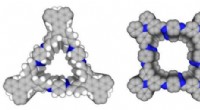
* Scanning Probe Microscopes: These use a tiny probe to scan a surface and create an image. They have very high resolution and can be used to image individual molecules.
* Indirect Methods: Scientists often use indirect methods to study molecules, such as:
* X-ray Crystallography: This technique uses X-rays to determine the arrangement of atoms in a molecule.
* Spectroscopy: This technique uses various forms of radiation to study the properties of molecules.
So, while we can't directly "see" molecules in the traditional sense, we have powerful tools that allow us to study their structure and behavior in great detail.