1. Minimizing Energy:
* Atoms are always trying to reach the most stable state, which is the state with the lowest energy.
* When atoms bond together, they form a structure that minimizes the energy of the system.
* This minimum energy state often corresponds to a regular, repeating arrangement of atoms, like a crystal lattice.
2. Strong Bonding:
* The bonds between atoms in a mineral are strong, usually ionic or covalent bonds.
* These strong bonds hold the atoms in a fixed position, resulting in a rigid structure.
* The repeating pattern of the crystal structure arises from the specific angles and distances that are required to optimize the strength of these bonds.
3. Atomic Packing:
* Atoms have specific sizes, and they tend to pack together efficiently to minimize empty space.
* This efficient packing often results in a repeating, symmetrical arrangement.
4. Crystallization Process:
* Minerals typically form from a liquid or gas phase through a process called crystallization.
* During crystallization, atoms or ions start to come together and bond.
* As the crystallization process progresses, the atoms continue to add onto the existing structure, forming a repeating pattern that expands outward.
5. Symmetry:
* The repeating pattern of a crystal structure often leads to a high degree of symmetry.
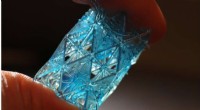
* This symmetry is a defining characteristic of crystals and can be observed in the external shape of the crystal.
In summary: The repeating pattern of a crystal structure is a result of the interplay between the forces of attraction between atoms, the need to minimize energy, and the tendency of atoms to pack together efficiently. This structure results in a solid with a highly ordered, repeating arrangement of atoms, which we call a crystal.