Here's why:
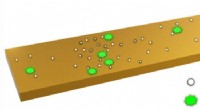
* Equilibrium is a dynamic state: It's not a static situation where the reaction has stopped. Instead, the forward and reverse reactions are occurring at the same rate. This means that the rate of formation of products equals the rate of formation of reactants.
* Relative amounts: While the *rates* are equal, the *amounts* of reactants and products can be very different. The relative amounts depend on the equilibrium constant (K).
* K > 1: Favors products. There will be more products than reactants at equilibrium.
* K < 1: Favors reactants. There will be more reactants than products at equilibrium.
* K = 1: Equilibrium is reached when the amounts of reactants and products are equal.
Example: Think of a reversible reaction where A + B <-> C + D. At equilibrium, the reaction hasn't stopped; it's just that the rate of formation of C and D is equal to the rate of formation of A and B. There might be a lot more C and D present, or a lot more A and B, depending on the value of K.