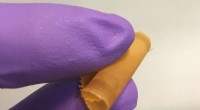
* Copper's Properties: Copper is a relatively unreactive metal, meaning it doesn't easily give up its electrons. However, it can be oxidized by strong oxidizing agents.
* Nitric Acid's Properties: Nitric acid is a strong oxidizing agent. It contains the nitrate ion (NO₃⁻), which readily accepts electrons.
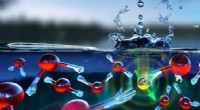
* The Reaction: When copper reacts with nitric acid, the nitrate ion (NO₃⁻) from nitric acid oxidizes the copper atoms, pulling electrons away from them. This results in the formation of copper ions (Cu²⁺). The nitrate ions are reduced to nitrogen oxides (NO₂ or NO) in the process.
Here's a simplified chemical equation:
Cu + 4HNO₃ → Cu(NO₃)₂ + 2NO₂ + 2H₂O
Key Points:
* Oxidation: Copper is oxidized, losing electrons and becoming copper ions.
* Reduction: Nitrate ions are reduced, gaining electrons and becoming nitrogen oxides.
* Formation of Copper Nitrate: The copper ions combine with nitrate ions to form copper nitrate (Cu(NO₃)₂), a soluble compound.
* Red-brown Gas: The nitrogen dioxide (NO₂) gas produced is a reddish-brown color, often observed in the reaction.
Important Note: The reaction between copper and nitric acid does not produce hydrogen gas (H₂), unlike the reaction of many metals with other acids like hydrochloric acid. This is because nitric acid is a strong enough oxidizing agent to prevent the formation of hydrogen.