Here's why ferromagnetism is not found in liquids and gases:
* Disordered structure: In liquids and gases, the atoms and molecules are in constant motion and have no fixed positions. This leads to a disordered structure where the magnetic moments are randomly oriented. The lack of long-range order prevents the formation of magnetic domains, essential for ferromagnetism.
* Weak interactions: In liquids and gases, the interatomic/intermolecular forces are much weaker compared to solids. This weakens the interactions between magnetic moments, further inhibiting the formation of long-range order.
* Thermal agitation: The increased kinetic energy of molecules in liquids and gases leads to thermal agitation, which further disrupts the alignment of magnetic moments.
In summary, the absence of a fixed, ordered structure, weaker interatomic forces, and thermal agitation in liquids and gases prevent the formation of magnetic domains, making ferromagnetism impossible in these states of matter.
However, there are exceptions:
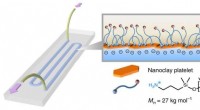
* Ferrofluids: These are colloidal suspensions of magnetic nanoparticles in a carrier fluid. The nanoparticles retain their ferromagnetic properties, making the fluid respond to magnetic fields.
* Paramagnetic gases: While not strictly ferromagnetic, some gases, like oxygen, exhibit paramagnetism, where their magnetic moments are weakly aligned in the presence of an external magnetic field.
Therefore, while ferromagnetism is not typically found in liquids and gases, there are some exceptions and variations in magnetic properties within these states of matter.