Both sodium chloride (NaCl) and magnesium oxide (MgO) are ionic compounds with a crystal lattice structure. This means their constituent ions are arranged in a highly ordered, repeating pattern.
Sodium Chloride (NaCl):
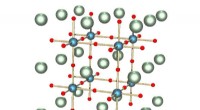
* Crystal Structure: Face-centered cubic (FCC) lattice.
* Ionic Arrangement: Sodium cations (Na+) and chloride anions (Cl-) alternate in a 1:1 ratio. Imagine a 3D "checkerboard" pattern where each ion is surrounded by six ions of the opposite charge.
* Bonding: Strong electrostatic attraction between oppositely charged ions.
* Properties: High melting and boiling points, hard and brittle, soluble in water.
Magnesium Oxide (MgO):
* Crystal Structure: Similar to NaCl, with a face-centered cubic lattice.
* Ionic Arrangement: Magnesium cations (Mg2+) and oxide anions (O2-) alternate in a 1:1 ratio. However, the arrangement is slightly different from NaCl due to the different charges of the ions.
* Bonding: Even stronger electrostatic attraction than in NaCl due to the higher charges of the ions.
* Properties: Very high melting and boiling points, extremely hard and brittle, insoluble in water.
Similarities:
* Both have cubic crystal structures.
* Both are ionic compounds with strong electrostatic forces holding them together.
* Both have high melting and boiling points due to the strong ionic bonds.
Differences:
* Size of ions: Mg2+ and O2- are smaller than Na+ and Cl-, leading to a denser packing in MgO.
* Charge of ions: Mg2+ and O2- have higher charges than Na+ and Cl-, resulting in stronger electrostatic forces and higher melting point in MgO.
* Solubility: NaCl is soluble in water, while MgO is insoluble.
In summary, both NaCl and MgO have similar crystal structures, but the differences in ionic size and charge lead to different properties, particularly in terms of melting point and solubility.