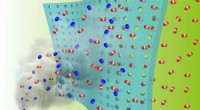
* Metals tend to lose electrons, becoming positively charged ions (cations).
* Nonmetals tend to gain electrons, becoming negatively charged ions (anions).
The attraction between these oppositely charged ions is what forms the ionic bond.
Key points:
* Electronegativity difference: Ionic bonds form when the electronegativity difference between the two atoms is large. Electronegativity is a measure of an atom's ability to attract electrons.
* Transfer of electrons: The metal atom donates one or more electrons to the nonmetal atom, creating a complete outer shell for both.
* Electrostatic attraction: The resulting ions are held together by strong electrostatic forces.
Examples:
* Sodium chloride (NaCl): Sodium (Na), a metal, loses an electron to chlorine (Cl), a nonmetal. The resulting positively charged sodium ion (Na+) and negatively charged chloride ion (Cl-) attract each other, forming an ionic bond.
* Magnesium oxide (MgO): Magnesium (Mg), a metal, loses two electrons to oxygen (O), a nonmetal. The resulting positively charged magnesium ion (Mg2+) and negatively charged oxide ion (O2-) attract each other, forming an ionic bond.
Characteristics of ionic compounds:
* High melting and boiling points: Due to the strong electrostatic forces holding them together.
* Crystalline structure: Ionic compounds form a regular, repeating pattern in their solid state.
* Conductivity: Ionic compounds conduct electricity when melted or dissolved in water, as the ions become mobile.
* Brittle: Ionic compounds are brittle because the ions are arranged in a rigid structure. A strong force can disrupt this structure, causing the compound to break.