1. Ions: Ionic compounds are made up of positively charged ions (cations) and negatively charged ions (anions).
2. Electrostatic Attraction: The opposite charges of these ions attract each other, creating a strong electrostatic force that holds them together.
3. Repeating Pattern: This attraction forces the ions to arrange themselves in a specific, repeating pattern, forming a lattice structure. This pattern extends in all directions, creating a vast, interconnected network of ions.
4. Unit Cell: The smallest repeating unit of the lattice is called the unit cell. It's like a building block that, when repeated in all directions, creates the entire crystal structure.
5. Lattice Points: The locations of the ions within the unit cell are called lattice points. These points are not just random, but precisely defined within the three-dimensional space of the crystal.
Why is the crystal lattice important?
* Stability: The lattice structure is crucial for the stability of ionic compounds. The strong electrostatic attraction between the ions is the main force that keeps the compound together.
* Shape and Properties: The arrangement of ions in the lattice determines the overall shape and physical properties of the crystal, such as its melting point, hardness, and conductivity.
* Reactivity: The lattice structure can also influence how readily an ionic compound reacts with other substances.
Example:
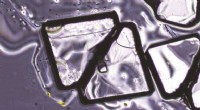
Sodium chloride (NaCl), or table salt, is a common example of an ionic compound. Its crystal lattice is a face-centered cubic structure. In this structure, sodium ions (Na+) and chloride ions (Cl-) alternate in a three-dimensional arrangement, forming a stable, repeating pattern.
Understanding crystal lattices is fundamental to understanding the behavior and properties of ionic compounds.