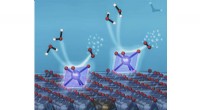
* Closely Packed Atoms: Metal atoms are tightly packed together in a regular, crystalline structure. This close proximity allows for efficient transmission of vibrations.
* Free Electrons: Metals have a "sea" of free electrons that can move easily throughout the material. These electrons interact with the vibrating atoms, transferring energy and propagating the sound wave.
* Strong Interatomic Bonding: The strong metallic bonds holding the atoms together allow for efficient transfer of vibrational energy between atoms.
How it works:
When a sound wave strikes a metal surface, it causes the atoms to vibrate. These vibrations are transferred to neighboring atoms through the strong metallic bonds. The free electrons also oscillate in response to the vibrations, further contributing to the transmission of the sound wave.
In contrast:
Materials like wood, rubber, or plastics have weaker interatomic bonds and fewer free electrons. This limits the ability of vibrations to travel through these materials, making them poor conductors of sound.
In summary:
The combination of tightly packed atoms, free electrons, and strong interatomic bonds in metals enables them to conduct sound very efficiently.