Here's how it works:
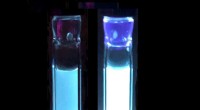
* Condensation: The chamber is filled with a supersaturated vapor (like alcohol or water vapor). This means the vapor is close to its condensation point.
* Ionization: When radioactive particles pass through the chamber, they ionize the vapor molecules. This creates tiny droplets of liquid around the ions.
* Tracks: These droplets form visible tracks, revealing the path of the radioactive particles.
Types of Cloud Chambers:
* Wilson Cloud Chamber: The classic design, often used in classrooms, where the vapor is created by expanding the chamber volume.
* Diffusion Cloud Chamber: A more sensitive design where vapor diffuses from a warm to a cold surface, creating a permanent supersaturated zone.
Advantages of Cloud Chambers:
* Direct visualization: Allows scientists to directly observe the paths of radioactive particles.
* Particle identification: The shape and length of the tracks can be used to identify the type of particle (alpha, beta, gamma).
* Simple and inexpensive: Relatively easy to construct, making them suitable for educational purposes.
Limitations of Cloud Chambers:
* Limited sensitivity: Not as sensitive as other detectors for low-level radioactivity.
* Not suitable for high-energy particles: High-energy particles can produce too many ions, making the tracks difficult to distinguish.
Let me know if you have any other questions about cloud chambers or other radiation detectors!