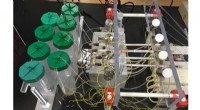
A constant volume gas thermometer is a device that utilizes the relationship between the pressure and temperature of an ideal gas at constant volume to measure temperature. This relationship is described by Gay-Lussac's Law, which states that the pressure of a gas at constant volume is directly proportional to its absolute temperature.
Here's how it works:
1. The Setup: The thermometer consists of a bulb filled with a known quantity of gas (usually helium or hydrogen) connected to a pressure gauge and a mechanism to adjust the volume. The bulb is placed in a thermal bath, and the volume is kept constant.
2. Pressure Measurement: As the temperature of the thermal bath changes, the pressure of the gas in the bulb also changes. The pressure gauge accurately measures these pressure variations.
3. Temperature Calculation: The change in pressure is directly proportional to the change in temperature. Knowing the initial pressure and temperature of the gas, the temperature can be calculated using the formula:
T = (P / P0) * T0
Where:
* T is the unknown temperature
* P is the pressure at the unknown temperature
* P0 is the pressure at a known temperature (usually the ice point)
* T0 is the known temperature (usually the ice point, which is 273.15 K)
Advantages of Constant Volume Gas Thermometers:
* High Precision: They are known for their high accuracy and precision in temperature measurement, especially at low temperatures.
* Calibration: They can be used to calibrate other thermometers, including those that rely on different physical properties.
* Ideal Gas Behavior: They are based on the behavior of an ideal gas, which is independent of the specific gas used.
Disadvantages of Constant Volume Gas Thermometers:
* Complex Design: They are more complex to build and operate compared to other thermometers.
* Slow Response: The thermometer's response to temperature changes can be slow, especially at low temperatures.
* Limited Range: Their range is usually limited to low temperatures.
Applications of Constant Volume Gas Thermometers:
* Calibrating other thermometers
* Measuring temperatures in scientific research
* Determining the triple point of water
While constant volume gas thermometers are not commonly used in everyday life, they remain vital in the scientific community for achieving highly precise temperature measurements. They serve as the standard against which other thermometers are calibrated, ensuring accuracy and reliability in scientific research and industry.