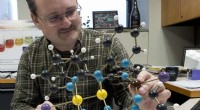
1. The Bohr Model: This model, proposed by Niels Bohr in 1913, is a simplified model that depicts the atom as a nucleus with electrons orbiting in specific circular paths called energy levels. While this model doesn't accurately represent the complex reality of electron movement, it provides a good starting point for understanding basic atomic structure and energy levels.
2. The Quantum Mechanical Model: This is the most accurate and modern model of the atom. It utilizes quantum mechanics to describe the probability of finding an electron in a specific region of space. This model represents electrons as "electron clouds" rather than fixed orbits, reflecting the uncertainty principle and the wave-particle duality of electrons.
3. The Shell Model: This model focuses on the arrangement of electrons in different energy levels or "shells" around the nucleus. It helps explain chemical bonding, ionization, and other properties of atoms.
4. The Orbital Model: This model builds on the quantum mechanical model by describing the specific shapes and orientations of electron orbitals. It utilizes atomic orbitals (s, p, d, and f) to represent the regions where electrons are most likely to be found.
5. Computational Models: These models utilize advanced algorithms and computer simulations to study the behavior of atoms and molecules. They can be used to analyze complex interactions, predict chemical reactions, and gain insights into the properties of materials.
Tools used to study atoms:
* Spectroscopy: Analyzing the light emitted or absorbed by atoms to determine their energy levels and identify elements.
* X-ray Diffraction: Used to study the arrangement of atoms in crystals and other solid materials.
* Electron Microscopy: Imaging techniques that use beams of electrons to magnify and visualize the structure of atoms and molecules.
* Particle Accelerators: Used to probe the structure of atoms and their subatomic particles by smashing them together at high speeds.
In conclusion, the choice of model for studying atoms depends on the specific question being asked and the level of detail required. No single model captures the entirety of atomic behavior, and scientists often use a combination of models and tools to gain a comprehensive understanding of the atom.