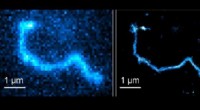
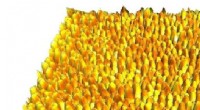
* Molecules are too small: Molecules are incredibly tiny – much smaller than the wavelength of visible light. Traditional microscopes use light to magnify objects, but light waves are too large to interact with individual molecules.
To "see" molecules, you need specialized techniques:
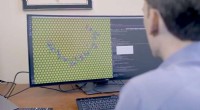
* Electron Microscopy (EM): This type of microscopy uses a beam of electrons instead of light. Electrons have a much shorter wavelength than light, allowing for much higher resolution and the ability to image individual atoms and molecules. There are different types of EM, such as Transmission Electron Microscopy (TEM) and Scanning Electron Microscopy (SEM).
* Scanning Probe Microscopy (SPM): This technique uses a sharp tip to scan a surface. The tip is so small that it can interact with individual atoms and molecules, creating a detailed 3D image. There are different types of SPM, such as Atomic Force Microscopy (AFM) and Scanning Tunneling Microscopy (STM).
* X-ray Crystallography: This technique uses X-rays to determine the 3D structure of molecules. It works by shining X-rays onto a crystal of the molecule, which causes the X-rays to diffract. By analyzing the diffraction pattern, scientists can determine the arrangement of atoms in the molecule.
* Nuclear Magnetic Resonance (NMR): This technique uses magnetic fields and radio waves to study the nuclei of atoms. It can provide information about the structure and dynamics of molecules.
In summary: While you can't see a molecule with your naked eye or a regular microscope, various sophisticated techniques allow scientists to "see" and study them in detail.