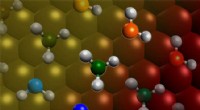
* Increased Spacing: The particles in a liquid are close together but can move around. When the liquid changes to a gas, the particles spread out much further apart, becoming much more mobile. This is why gases can expand to fill their container.
* Increased Energy: The particles in a gas have more kinetic energy than those in a liquid. This means they are moving around more quickly and with more force. This increased energy is the driving force behind the change of state.
* Breaking Intermolecular Forces: In a liquid, particles are held together by intermolecular forces, like hydrogen bonds or dipole-dipole interactions. To become a gas, these forces need to be overcome. The particles need enough energy to break free from their neighbors and move around independently.
Think of it like this:
Imagine a crowd of people in a crowded room (liquid). They're close together and can move around a bit. But if you give them a lot of energy (heat), they will spread out, move around more freely, and even leave the room (gas).
How does this happen?
This process, known as vaporization, can happen in two ways:
* Evaporation: This is a slow process that happens at the surface of a liquid. The particles with the most energy escape the liquid's surface and become gas particles.
* Boiling: This is a faster process that happens when the liquid reaches its boiling point. At this point, enough energy is added to the liquid that all the particles have enough energy to overcome the intermolecular forces and become gas particles.
Let me know if you'd like to know more about any of these processes!