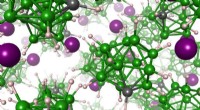
* Increased kinetic energy: Atoms start moving faster and vibrating more vigorously. This increased motion is what we perceive as an increase in temperature.
* Electrons move to higher energy levels: Electrons within the atom can absorb the energy and jump to higher energy levels further from the nucleus. This is often associated with changes in the atom's chemical properties.
* Phase changes: If enough heat is applied, atoms can overcome the attractive forces holding them together in a solid or liquid state, causing a change in the state of matter. For example, water molecules in ice will break free and become liquid water when heated.
Here's a breakdown of each effect:
1. Increased Kinetic Energy:
* Gases: In gases, atoms are already relatively far apart and move freely. Heating them causes them to move even faster, which translates to higher pressure.
* Liquids: Heating a liquid makes the molecules move faster, allowing them to spread out more. This causes the liquid to expand and become less dense.
* Solids: In solids, atoms are closely packed in a rigid structure. Heating them causes them to vibrate more vigorously, which can lead to expansion of the solid.
2. Excited Electrons:
* When electrons absorb energy from heat, they jump to higher energy levels. This is called excitation.
* Excited electrons are unstable and will eventually release the energy, often in the form of light. This is how we see the color of heated objects, like the orange glow of a hot metal.
* Excited electrons can also lead to chemical reactions, as they are more likely to participate in bond formation or breaking.
3. Phase Changes:
* Melting: Heating a solid can provide enough energy for the atoms to break free from their fixed positions and move around more freely, changing the solid to a liquid.
* Boiling/Evaporation: Heating a liquid can give enough energy for some of the molecules to overcome the attractive forces holding them together, allowing them to escape as a gas.
* Sublimation: In some cases, a solid can directly change to a gas without becoming a liquid, like dry ice.
In summary, heating atoms increases their energy, causing them to move faster, excite their electrons, and potentially change their state of matter.