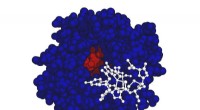
* CO2 and H+ bind to hemoglobin: CO2 reacts with water in red blood cells to form carbonic acid (H2CO3), which dissociates into H+ and bicarbonate (HCO3-). These protons (H+) bind to hemoglobin, altering its structure.
* Structural change in hemoglobin: The binding of H+ causes a conformational change in the hemoglobin molecule. This change decreases the affinity of hemoglobin for oxygen, making it easier to release oxygen into the tissues.
* Facilitating oxygen delivery: This decrease in affinity is crucial for delivering oxygen to tissues that are metabolically active and producing more CO2 and H+, thus having a lower pH. These tissues require more oxygen.
Essentially, the Bohr effect is a mechanism that helps to ensure that oxygen is delivered to the tissues that need it most.