The Setup
* Alpha particles: Imagine a stream of tiny, positively charged particles (alpha particles) being fired like bullets from a source.
* Gold foil: A thin sheet of gold foil acts as the target.
* Detector screen: Surrounding the gold foil is a screen coated with a material that glows when hit by alpha particles.
The Animation
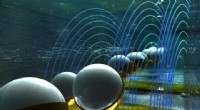
1. Most particles pass straight through: The animation shows the majority of the alpha particles passing straight through the gold foil and striking the screen directly behind it. This suggests that most of the atom is empty space.
2. Some particles are deflected: However, a small number of particles are deflected, changing their path as they pass through the foil. Some are deflected slightly, while others are deflected at much larger angles.
3. A few particles are deflected backwards: The most striking observation is that a few particles are deflected almost directly backwards, as if they had bounced off a solid object.
Rutherford's Interpretation
Rutherford interpreted these results as follows:
* Empty space: The fact that most particles pass through the gold foil suggests that atoms are mostly empty space.
* Dense, positive nucleus: The deflection of some particles indicates the presence of a small, dense, positively charged region within the atom, which he called the nucleus.
* Repulsion: The large deflections and backward scattering occur because alpha particles (positive) are repelled by the positive nucleus. This repulsion is much stronger when the alpha particle comes close to the nucleus.
The Animation Highlights
* The animation should emphasize the relative sizes of the nucleus and the atom, showing that the nucleus is much smaller.
* It should also show the different trajectories of the alpha particles – straight paths, slight deflections, and large deflections.
* The animation should clearly demonstrate that a very small percentage of particles experience significant deflections.
Conclusion
The gold foil experiment, as visualized in the animation, revolutionized our understanding of the atom. Rutherford's model, based on this evidence, is still the foundation of our current understanding of atomic structure.