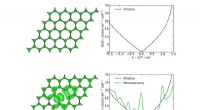
Solids:
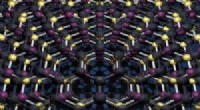
* Highly ordered: Particles in a solid are tightly packed together in a fixed, regular arrangement. This arrangement forms a crystalline lattice or a highly ordered, repeating pattern.
* Strong intermolecular forces: The particles are held together by strong intermolecular forces, such as ionic bonds, covalent bonds, or metallic bonds. These forces restrict movement.
* Low kinetic energy: Particles in a solid have low kinetic energy, meaning they vibrate in place but don't move freely.
* Fixed shape and volume: Due to the fixed arrangement and limited movement, solids maintain a definite shape and volume. They are incompressible.
Liquids:
* Less ordered: Particles in a liquid are closer together than in a gas, but they are not in a fixed arrangement. They have some degree of short-range order, but not the long-range order of a solid.
* Weaker intermolecular forces: Liquids have weaker intermolecular forces than solids, allowing particles to slide past each other. This is why liquids are fluid.
* Higher kinetic energy: Particles in a liquid have higher kinetic energy than in a solid, allowing them to move more freely.
* Fixed volume, but variable shape: Liquids have a definite volume but take the shape of their container because the particles can flow. They are slightly compressible.
Here's a simple analogy:
Think of a classroom with students.
* Solid: The students are all sitting in their assigned seats, forming a fixed, ordered pattern.
* Liquid: The students are standing in a crowded room, bumping into each other but able to move around.
Key differences:
* Order: Solids are highly ordered, while liquids are less ordered.
* Intermolecular forces: Solids have stronger intermolecular forces than liquids.
* Kinetic energy: Solids have lower kinetic energy than liquids.
* Shape and volume: Solids have a fixed shape and volume, while liquids have a fixed volume but variable shape.