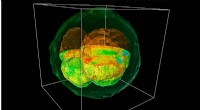
At Room Temperature (Solid State):
* Vibrations: Iron atoms in a solid are tightly packed in a crystalline lattice. They don't move freely, but they vibrate constantly around their fixed positions.
* Low Kinetic Energy: The vibrations are relatively slow and have low kinetic energy. This is why solids maintain their shape and volume.
As Heat is Applied:
* Increased Vibrations: Heat energy is absorbed by the iron atoms. This energy causes them to vibrate more vigorously and with greater amplitude.
* Higher Kinetic Energy: The increased vibrations mean the atoms have higher kinetic energy.
* Expansion: The increased vibrations cause the atoms to push slightly further apart, leading to an overall expansion of the iron block. This is why metals expand when heated.
* Phase Change: As the temperature continues to rise, the atoms vibrate with so much energy that they start to break free from their fixed positions. This is the transition from a solid to a liquid (melting).
Key Points:
* Temperature and Kinetic Energy: The higher the temperature, the greater the kinetic energy of the atoms.
* Solid State: In a solid, the molecules are fixed in a lattice structure and primarily vibrate.
* Expansion: Heat causes expansion because the molecules move farther apart due to increased vibrations.
Let me know if you have any other questions!