Kinetic theory provides a powerful framework to understand boiling, a phase transition from liquid to gas. Here's how:
1. Molecular Motion: Kinetic theory states that matter is composed of constantly moving molecules. In liquids, these molecules are closely packed and experience strong attractive forces, but still possess enough kinetic energy to move and slide past each other.
2. Temperature and Energy: Temperature is a measure of the average kinetic energy of the molecules. As temperature increases, the molecules move faster and have more kinetic energy.
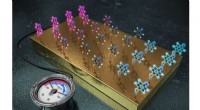
3. Vapor Pressure: At any given temperature, some molecules at the liquid's surface have enough kinetic energy to overcome the attractive forces and escape into the gas phase. This creates a vapor pressure above the liquid.
4. Boiling Point: As the temperature increases, more molecules gain enough energy to escape, and the vapor pressure rises. The boiling point is the temperature at which the vapor pressure equals the external atmospheric pressure. At this point, bubbles of vapor form within the liquid, indicating a transition to the gas phase.
5. Heat of Vaporization: To transition from liquid to gas, molecules must overcome the attractive forces holding them together. This requires energy, known as the heat of vaporization. This energy is absorbed from the surrounding environment, which is why boiling is an endothermic process.
In summary:
* Increased temperature leads to increased kinetic energy of liquid molecules.
* This increased kinetic energy allows some molecules to overcome the intermolecular forces and escape into the gas phase, increasing vapor pressure.
* When vapor pressure equals atmospheric pressure, the boiling point is reached, and the liquid boils.
Key Points:
* Boiling is not simply about the liquid getting hot; it's about the molecules gaining enough energy to escape into the gas phase.
* The boiling point is dependent on external atmospheric pressure. Lower pressure means a lower boiling point, as the molecules need less energy to escape.
* The heat of vaporization explains why boiling requires energy input.
By understanding the principles of kinetic theory, we can gain a deeper understanding of the complex phenomenon of boiling.