Wave-Particle Duality:
* Wave-like behavior: Light exhibits wave-like characteristics, such as diffraction (bending around obstacles) and interference (creating patterns when waves overlap).
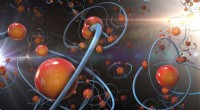
* Particle-like behavior: Light also behaves as particles called photons, which possess energy and momentum. This is demonstrated in the photoelectric effect, where light ejects electrons from a metal surface.
Electromagnetic Spectrum:
* Wavelength: Light can be categorized by its wavelength, which determines its color. The visible spectrum ranges from violet (shortest wavelength) to red (longest wavelength). Beyond the visible spectrum are other forms of electromagnetic radiation like infrared, ultraviolet, X-rays, and gamma rays.
* Frequency: Light's frequency is inversely proportional to its wavelength, meaning higher frequency corresponds to shorter wavelengths.
Other Properties:
* Speed: In a vacuum, light travels at the fastest possible speed in the universe, approximately 299,792,458 meters per second (often rounded to 3 x 10⁸ m/s).
* Reflection: Light bounces off surfaces, changing its direction. This is how we see objects.
* Refraction: Light bends when it passes from one medium to another (e.g., from air to water). This is responsible for the way objects appear distorted when submerged in water.
* Polarization: Light waves can oscillate in different directions. Polarization is the property of light where the oscillations are restricted to a specific plane.
* Intensity: This refers to the brightness of light, which is related to the energy carried by the light waves.
* Color: The color of light is determined by its wavelength. We perceive different wavelengths as different colors.
Quantum Properties:
* Photon Energy: Each photon carries a specific amount of energy, which is directly proportional to its frequency (and inversely proportional to its wavelength).
* Quantization: Light energy is quantized, meaning it can only exist in discrete packets (photons) rather than as a continuous wave.
Importance of Light:
Light plays a crucial role in our lives, from enabling us to see the world around us to powering photosynthesis and various technologies. It is also a fundamental tool for scientific exploration, allowing us to study distant objects in the universe and probe the secrets of matter.