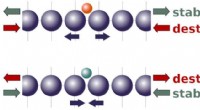
Here's why:
* Stability of a full d-orbital: A completely filled d-orbital (d¹⁰) provides extra stability. This is due to the pairing of electrons, which leads to lower energy levels and a more stable configuration.
* Energy difference: While the 4s orbital is generally considered lower in energy than the 3d orbital, this energy difference can be small. In the case of copper, the energy gained by promoting one electron from the 4s to the 3d orbital outweighs the energy difference, leading to a more stable full 3d¹⁰ configuration.
Think of it this way: It's like having a filled box (3d¹⁰) is more desirable than having a partially filled box (3d⁹) and a full box (4s²), even if the filled box (4s²) is slightly lower in energy.
This phenomenon, where a single electron is moved to a higher energy level to achieve a filled or half-filled subshell, is not unique to copper. It also occurs in other elements like chromium (Cr).
Let me know if you have any more questions about electron configurations!