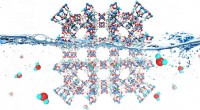
* The solid breaks down: The solid breaks apart into individual molecules or ions.
* The molecules/ions get surrounded: These individual pieces become surrounded by the molecules of the solvent (usually water). This process is called solvation.
* The solution forms: The dissolved solid and the solvent form a homogeneous mixture called a solution.
Where does it go?
* It's still there! The dissolved solid doesn't vanish, it's just distributed evenly throughout the solution.
* Example: When you add sugar to water, the sugar molecules break down and become surrounded by water molecules. The sugar is still there, but you can't see it because it's mixed evenly with the water.
What can happen to the dissolved solid:
* Evaporation: If you evaporate the solvent (like water), the dissolved solid will be left behind.
* Crystallization: In some cases, you can get the dissolved solid to crystallize out of the solution by changing the temperature, pressure, or adding another substance.
* Chemical reactions: The dissolved solid might participate in chemical reactions within the solution.
Let me know if you have any more questions!