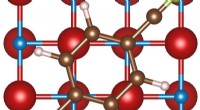
CaCO₃(s) + 2HF(aq) → CaF₂(s) + H₂O(l) + CO₂(g)
Here's a breakdown of the reaction:
* Reactants:
* Calcium carbonate (CaCO₃) is a solid.
* Hydrofluoric acid (HF) is an aqueous solution (dissolved in water).
* Products:
* Calcium fluoride (CaF₂) is a solid.
* Water (H₂O) is a liquid.
* Carbon dioxide (CO₂) is a gas.
Explanation of the Balancing:
* Calcium (Ca): There is one calcium atom on both sides of the equation.
* Carbon (C): There is one carbon atom on both sides.
* Oxygen (O): There are three oxygen atoms on the left (in CaCO₃) and three on the right (one in H₂O and two in CO₂).
* Hydrogen (H): There are two hydrogen atoms on the left (in 2HF) and two on the right (in H₂O).
* Fluorine (F): There are two fluorine atoms on the left (in 2HF) and two on the right (in CaF₂).
This reaction is an example of an acid-base reaction, where the hydrofluoric acid (HF) acts as the acid and the calcium carbonate (CaCO₃) acts as the base. The reaction produces calcium fluoride, water, and carbon dioxide.