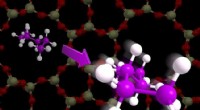
* Pyramidal Shape: Ammonia has a trigonal pyramidal shape. This means the nitrogen atom is at the apex of a pyramid, with the three hydrogen atoms forming the base.
* Lone Pair: The nitrogen atom in ammonia has one lone pair of electrons. This lone pair takes up space and influences the molecule's shape, pushing the hydrogen atoms away from it.
* Bond Angles: The H-N-H bond angles in ammonia are approximately 107 degrees, which is less than the ideal 109.5 degrees found in a perfect tetrahedron. This is due to the repulsion between the lone pair and the bonding pairs of electrons.
Two-dimensional representations often fail to capture these key features:
* Simple Lewis Structures: While Lewis structures show the bonding and lone pairs, they don't accurately depict the pyramidal shape or bond angles.
* Flat Drawings: A simple drawing of ammonia as a flat triangle with a nitrogen atom in the middle and three hydrogen atoms attached can be misleading, as it doesn't represent the true 3D structure.
To accurately represent ammonia, you need to use:
* Perspective Drawings: These use lines and angles to show the depth and shape of the molecule.
* 3D Models: Physical models or computer simulations allow for a more realistic representation of the molecule's geometry.
In summary: The three-dimensional structure of ammonia, including its pyramidal shape and the effect of the lone pair, makes it challenging to represent accurately in two dimensions.