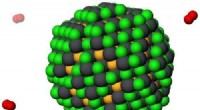
* Ionic Compounds: Copper nitrate is an ionic compound, meaning it's formed by the electrostatic attraction between positively charged copper ions (Cu²⁺) and negatively charged nitrate ions (NO₃⁻).
* Polar Bonds: The bonds within the nitrate ion (N-O bonds) are polar due to the difference in electronegativity between nitrogen and oxygen. This results in an uneven distribution of electron density within the nitrate ion.
* Asymmetrical Structure: The nitrate ion (NO₃⁻) has a trigonal planar structure, with three oxygen atoms arranged symmetrically around the central nitrogen atom. However, the copper ion is not symmetrically located, resulting in an overall asymmetrical structure for the copper nitrate molecule.
* Dipole Moment: The asymmetry and polar bonds within the copper nitrate molecule create a net dipole moment, meaning there is a separation of charge within the molecule. This makes copper nitrate a polar compound.
In summary: The presence of polar bonds, the asymmetrical structure, and the resulting dipole moment classify copper nitrate as a polar compound.