Here's why:
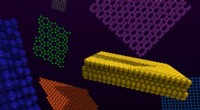
* Covalent bonding: Silicon dioxide consists of silicon atoms covalently bonded to oxygen atoms in a continuous, three-dimensional network. Each silicon atom is bonded to four oxygen atoms, and each oxygen atom is bonded to two silicon atoms.
* Strong bonds: The covalent bonds in silicon dioxide are very strong, making it a very hard and high-melting point solid.
* No discrete molecules: Unlike molecular solids, which have distinct molecules, silicon dioxide has a continuous network structure, meaning there are no individual SiO₂ molecules.
Other characteristics of covalent network solids include:
* High melting and boiling points: Due to the strong covalent bonds, a lot of energy is required to break them.
* Insolubility: They are typically insoluble in most solvents because the strong covalent bonds are difficult to disrupt.
* Hard and brittle: The rigid structure makes them hard but also brittle, as they tend to shatter rather than bend.
Examples of other covalent network solids include diamond, graphite, and quartz.