Here's the chemical equation for the reaction:
FeCl₃ (aq) + 3NaOH (aq) → Fe(OH)₃ (s) + 3NaCl (aq)
Let's break down what happens:
* Iron chloride (FeCl₃) is a soluble ionic compound, meaning it dissolves in water to form iron (III) ions (Fe³⁺) and chloride ions (Cl⁻).
* Sodium hydroxide (NaOH) is also a soluble ionic compound, dissolving in water to form sodium ions (Na⁺) and hydroxide ions (OH⁻).
When these solutions are mixed, the ions rearrange:
* The iron (III) ions (Fe³⁺) react with the hydroxide ions (OH⁻) to form iron(III) hydroxide (Fe(OH)₃). This compound is insoluble in water, meaning it does not dissolve and forms a solid precipitate.
* The sodium ions (Na⁺) and chloride ions (Cl⁻) remain in solution as sodium chloride (NaCl), which is soluble in water.
The result:
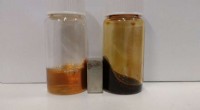
* A brown, gelatinous precipitate of iron(III) hydroxide (Fe(OH)₃) forms in the solution.
* The solution also contains sodium chloride (NaCl), which remains dissolved.
This reaction is an example of a precipitation reaction, where two soluble ionic compounds react to form an insoluble precipitate.