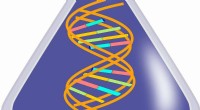
1. DNA: This is the genetic material itself, a long, double-stranded molecule containing the instructions for building and maintaining an organism.
2. Proteins: These are primarily:
* Histones: These are basic proteins that package and organize DNA into nucleosomes. They are responsible for the first level of DNA compaction. There are five main types of histones: H1, H2A, H2B, H3, and H4.
* Non-histone proteins: These are a diverse group of proteins that play various roles in chromatin structure and function. They include:
* Structural proteins: Help organize and maintain the overall structure of chromatin.
* Regulatory proteins: Involved in controlling gene expression, including transcription factors, DNA repair enzymes, and others.
Nucleosomes: The basic unit of chromatin is the nucleosome. It consists of a segment of DNA wrapped around a core of eight histone proteins (two each of H2A, H2B, H3, and H4).
Higher-order structures: Nucleosomes are further organized into higher-order structures, such as solenoids and loops, which further condense the DNA and contribute to the complex organization of chromosomes.
Overall, chromatin is a dynamic and complex structure that constantly changes in response to cellular signals. Its composition and organization play a vital role in regulating gene expression and maintaining genomic stability.