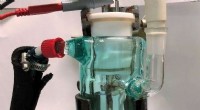
* Electrolysis: Electrolysis is the process of using an electric current to drive a non-spontaneous chemical reaction.
* Cathode: The cathode is the negatively charged electrode in an electrolytic cell.
* Discharge: At the cathode, positively charged ions (cations) are attracted and gain electrons, becoming neutral atoms or molecules.
In a dilute silver chloride solution, the following occurs:
1. Silver Chloride (AgCl) dissolves slightly: Some AgCl dissolves to form silver ions (Ag+) and chloride ions (Cl-).
2. Hydrogen ions (H+) are also present: Since the solution is dilute, water molecules will also dissociate to a small extent, producing hydrogen ions (H+).
3. Cathode: At the cathode, both Ag+ and H+ are attracted. However, silver has a higher reduction potential than hydrogen. This means that silver ions are more easily reduced than hydrogen ions.
4. Silver Deposition: The Ag+ ions gain electrons at the cathode and are reduced to metallic silver (Ag), which is deposited on the cathode surface.
Reaction at the cathode:
Ag+ + e- → Ag (s)
Therefore, silver is the primary product discharged at the cathode during the electrolysis of dilute silver chloride solution.