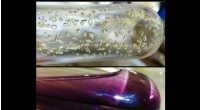
Here's the balanced chemical equation:
3NaOH(aq) + Al₂(SO₄)₃(aq) → 2Al(OH)₃(s) + 3Na₂SO₄(aq)
Explanation:
* Reactants: Sodium hydroxide (NaOH) and aluminum sulfate (Al₂(SO₄)₃) are the starting materials. Both are typically dissolved in water, hence the "(aq)" designation.
* Products: Aluminum hydroxide (Al(OH)₃) is a white, gelatinous precipitate that forms. This is why the "(s)" designation is used. Sodium sulfate (Na₂SO₄) remains dissolved in the solution, represented by "(aq)".
* Balancing: The coefficients (3, 1, 2, and 3) ensure that the number of atoms of each element is the same on both sides of the equation.
Important Note: This reaction is also an example of a precipitation reaction, as a solid (Al(OH)₃) is formed from the reaction of two aqueous solutions.