The Reaction:
* Ferric ions (Fe³⁺) react with ammonia (NH₃) to form a complex ion called hexaammineiron(III) ion [Fe(NH₃)₆]³⁺:
Fe³⁺ (aq) + 6NH₃ (aq) → [Fe(NH₃)₆]³⁺ (aq)
* The [Fe(NH₃)₆]³⁺ ion is then hydrolyzed in water, resulting in the release of H⁺ ions and formation of a hydroxide precipitate (Fe(OH)₃):
[Fe(NH₃)₆]³⁺ (aq) + 3H₂O (l) → Fe(OH)₃ (s) + 6NH₄⁺ (aq)
The Result:
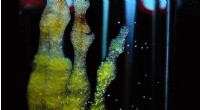
* The reddish-brown precipitate observed is ferric hydroxide (Fe(OH)₃).
* The solution also contains ammonium ions (NH₄⁺).
Additional Notes:
* The amount of ammonia added determines the outcome.
* If ammonia is added in excess, the precipitate may dissolve to form a colorless solution containing the [Fe(NH₃)₆]³⁺ complex ion.
* The reaction is an example of a complexation reaction, where a metal ion forms a complex with ligands (in this case, ammonia molecules).
* The formation of the precipitate is a reversible reaction. Adding acid can redissolve the precipitate by shifting the equilibrium towards the formation of [Fe(NH₃)₆]³⁺.
This reaction is a common laboratory test for the presence of ferric ions.