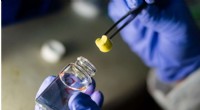
* Reaction with Carbon Dioxide: NaOH is a strong base and readily absorbs carbon dioxide (CO2) from the air. This reaction forms sodium carbonate (Na2CO3) and water (H2O):
2 NaOH + CO2 → Na2CO3 + H2O
* Evaporation: Water in the solution will evaporate, especially if the beaker is left in a dry or warm environment. This will increase the relative concentration of NaOH in the remaining solution.
Overall Impact:
The absorption of CO2 will decrease the concentration of NaOH, while evaporation will increase it. However, the reaction with CO2 is a more significant factor, so the overall effect is a decrease in NaOH concentration.
Important Notes:
* The rate of change: The rate of change in concentration depends on factors like:
* Exposure to air: A beaker with a wider opening will be exposed to more CO2, leading to faster reaction.
* Humidity: High humidity will slow down evaporation.
* Temperature: Higher temperature accelerates both the reaction with CO2 and evaporation.
* Solution Strength: A more concentrated solution will have a slower rate of change compared to a diluted solution.
Practical Implications:
* Storage: To minimize changes in concentration, it's recommended to store NaOH solutions in airtight containers.
* Calibration: Solutions used for precise measurements should be freshly prepared or standardized frequently to account for concentration changes.