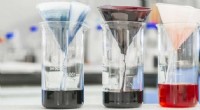
Ammonia (NH₃) in solution turns red litmus paper blue because it is a base.
* Basic nature of ammonia: Ammonia dissolved in water forms ammonium hydroxide (NH₄OH), which releases hydroxide ions (OH⁻) into the solution:
NH₃(g) + H₂O(l) ⇌ NH₄⁺(aq) + OH⁻(aq)
* Litmus paper as an indicator: Litmus paper contains a dye that changes color depending on the pH of the solution. Red litmus paper is acidic, and it turns blue in the presence of a base (alkaline) solution.
Dry ammonia gas has no action on litmus paper because it cannot form ammonium hydroxide without water.
* Dry ammonia doesn't ionize: In the absence of water, ammonia does not ionize to release hydroxide ions. It remains as NH₃ molecules, which cannot interact with the litmus dye.
* No change in pH: Without the formation of OH⁻ ions, the pH of the dry ammonia gas doesn't change significantly, and the litmus paper remains red.
In summary:
* Ammonia in solution (NH₄OH) is basic due to the formation of OH⁻ ions.
* Dry ammonia gas (NH₃) is not basic because it doesn't ionize to form OH⁻ ions.
Let me know if you have any other questions!