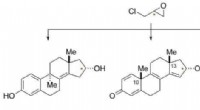
Reaction Equation:
CH₃COCl (l) + AgNO₃ (aq) → CH₃CO₂Ag (aq) + AgCl (s) + HNO₃ (aq)
Explanation:
* Ethanoyl chloride (CH₃COCl) is a reactive acyl chloride.
* Aqueous silver nitrate (AgNO₃) provides the nitrate ion (NO₃⁻) and silver ion (Ag⁺).
* Silver chloride (AgCl) is a white precipitate that forms, indicating the reaction has occurred.
* Ethanoic acid (CH₃CO₂H) is a weak acid formed as a byproduct of the reaction.
* Nitric acid (HNO₃) is a strong acid also formed as a byproduct.
Mechanism:
The reaction proceeds through a nucleophilic acyl substitution mechanism.
1. Nucleophilic attack: The nitrate ion (NO₃⁻) acts as a nucleophile, attacking the carbonyl carbon of ethanoyl chloride.
2. Leaving group departure: The chlorine atom, a good leaving group, departs from the carbonyl carbon, forming a tetrahedral intermediate.
3. Proton transfer: A proton is transferred from the tetrahedral intermediate to the nitrate ion, regenerating the nitrate ion and forming ethanoic acid (CH₃CO₂H).
4. Formation of silver ethanoate: The silver ion (Ag⁺) reacts with the ethanoate ion (CH₃CO₂⁻) to form silver ethanoate (CH₃CO₂Ag), which remains in solution.
Overall, the reaction between ethanoyl chloride and aqueous silver nitrate results in the formation of silver chloride precipitate, silver ethanoate in solution, and nitric acid.





![Dual Isomers of [IrC₄H₂]⁺ Reveal Separate Catalytic Paths: One Activates Methane, the Other Converts Water to CO](https://www.scienceaq.com/article/uploadfiles/202210/2022100914113319_S.jpg)