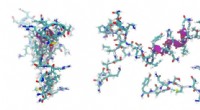
* Disulfide bonds are the strongest type of bond involved in protein structure. They are covalent bonds formed between the sulfur atoms of cysteine residues. These bonds are very stable and require significant energy to break.
* Hydrogen bonds are weaker than disulfide bonds, but still important for protein structure. They form between polar groups within the protein.
* Hydrophobic interactions are the weakest type of bond involved in protein structure. They arise from the tendency of nonpolar side chains to cluster together, avoiding contact with water.
* Ionic bonds are stronger than hydrophobic interactions but weaker than hydrogen bonds. They form between oppositely charged amino acid side chains.
In summary:
When an enzyme is heated, the weakest bonds (hydrophobic interactions) break first. As the temperature increases, hydrogen bonds and ionic bonds break, and finally, the strongest bonds (disulfide bonds) break. This process is called denaturation, where the enzyme loses its three-dimensional structure and its function.