Step-by-Step Formation and Why Excess Ammonia is Needed:
1. Initial Reaction: When ammonia is first added to a copper(II) solution (e.g., Cu²⁺(aq)), a pale blue precipitate of copper(II) hydroxide, Cu(OH)₂(s), forms. This is due to the reaction of copper ions with hydroxide ions produced from the equilibrium of ammonia in water:
```
Cu²⁺(aq) + 2OH⁻(aq) ⇌ Cu(OH)₂(s)
```
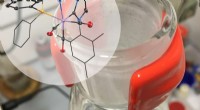
2. Complex Formation: As more ammonia is added, the precipitate dissolves, and a deep blue solution appears. This is because ammonia acts as a ligand, coordinating with the copper(II) ion to form complex ions. The initial reaction is the formation of the diamine complex:
```
Cu²⁺(aq) + 2NH₃(aq) ⇌ [Cu(NH₃)₂]²⁺(aq)
```
3. Tetraamine Complex: Adding even more ammonia shifts the equilibrium further, leading to the formation of the tetraaminecopper(II) complex:
```
[Cu(NH₃)₂]²⁺(aq) + 2NH₃(aq) ⇌ [Cu(NH₃)₄]²⁺(aq)
```
Why Excess Ammonia is Necessary:
* Solubility: The formation of the tetraamine complex is favored by the common ion effect. Excess ammonia forces the equilibrium toward the formation of the tetraamine complex by removing the free copper(II) ions from solution, preventing further precipitation of Cu(OH)₂.
* Stability: The tetraamine complex is more stable than the diamine complex. The excess ammonia pushes the equilibrium further to the right, favoring the formation of the tetraamine complex.
* Deep Blue Color: The intense deep blue color is characteristic of the tetraaminecopper(II) complex. Without sufficient ammonia, the solution will appear paler blue or even greenish due to the presence of other complex ions.
In Summary: Excess ammonia is needed to:
* Dissolve the initial copper(II) hydroxide precipitate
* Drive the equilibrium towards the formation of the tetraamine complex
* Achieve the characteristic deep blue color of the tetraaminecopper(II) complex.