1. They are the reacting units:
Atoms are the smallest units of an element that can participate in a chemical reaction. They combine and rearrange to form molecules and compounds.
2. They are conserved:
In a chemical reaction, atoms are neither created nor destroyed. They are simply rearranged. This is known as the Law of Conservation of Mass.
3. They determine the products:
The types and number of atoms involved in a reaction dictate the products that will be formed. Different arrangements of the same atoms can lead to entirely different substances.
4. They can be represented in chemical equations:
Chemical equations use symbols to represent atoms and molecules, showing how they interact during a reaction.
Example:
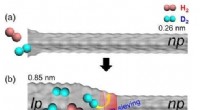
Consider the reaction of hydrogen gas (H₂) with oxygen gas (O₂) to form water (H₂O):
* Reactants: 2 hydrogen atoms (H) and 1 oxygen atom (O)
* Products: 2 hydrogen atoms (H) and 1 oxygen atom (O)
The chemical equation for this reaction is:
2H₂ + O₂ → 2H₂O
This equation shows that two molecules of hydrogen (2H₂) react with one molecule of oxygen (O₂) to form two molecules of water (2H₂O). The atoms are rearranged, but the total number of hydrogen and oxygen atoms remains the same.
Key Points:
* Atoms are the fundamental units involved in chemical reactions.
* They are conserved during the reaction.
* The arrangement of atoms determines the products formed.
* Chemical equations represent the atoms and molecules involved in a reaction.
Understanding the role of atoms in chemical reactions is essential for comprehending the fundamental principles of chemistry.