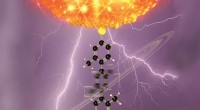
* Covalent Bonding: HCl exists as a gas at room temperature. The hydrogen and chlorine atoms are bonded together covalently, sharing electrons. This means there are no free-moving charged particles (ions) to carry an electrical current.
However, when HCl dissolves in water (forming hydrochloric acid), it becomes an excellent conductor of electricity:
* Ionization: HCl molecules react with water, breaking apart into hydrogen ions (H+) and chloride ions (Cl-):
```
HCl(g) + H2O(l) → H3O+(aq) + Cl-(aq)
```
* Free Ions: The presence of these free ions, which are charged particles, allows electricity to flow through the solution. The positively charged hydrogen ions move towards the negative electrode (cathode), and the negatively charged chloride ions move towards the positive electrode (anode).
In summary:
* Gaseous HCl is a poor conductor because it lacks free ions.
* Aqueous HCl (hydrochloric acid) is a good conductor because it ionizes, producing free ions that carry the electrical current.