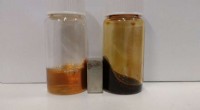
Pure substances have a specific, well-defined boiling point. This is because the molecules of a pure substance have consistent intermolecular forces, resulting in a consistent temperature at which they transition from liquid to gas.
Impurities can affect the boiling point. Impurities can:
* Raise the boiling point: If the impurity has a higher boiling point than the main substance, it will take a higher temperature to vaporize the mixture.
* Lower the boiling point: If the impurity has a lower boiling point than the main substance, it will vaporize first, leaving behind a less pure sample.
* Create a boiling point range: Impurities often cause a mixture to boil over a range of temperatures, rather than at a single, sharp point.
Here's how you can use boiling point to assess purity:
1. Compare to known values: If you know the theoretical boiling point of the pure substance, you can compare it to the observed boiling point of your sample. A significant difference suggests impurities.
2. Look for a boiling point range: If the substance boils over a range of temperatures, it's likely impure.
3. Observe the appearance of the vapor: A pure substance should vaporize cleanly without leaving residue. Impurities can cause discoloration or other abnormalities in the vapor.
However, boiling point alone is not a definitive measure of purity:
* Some impurities have similar boiling points: If the impurity has a boiling point very close to the main substance, it might not be detectable by boiling point alone.
* Other methods are needed: Other techniques like chromatography, spectroscopy, or titration are often necessary for more precise purity assessments.
In summary:
While boiling point can be a useful indicator of purity, it should be used in conjunction with other methods to obtain a reliable assessment of the substance's purity. It's crucial to consider the specific substance and potential impurities when evaluating purity based on boiling point.