1. The Chemical Equation:
* The most basic and fundamental way to represent a reaction. It uses symbols to show the reactants (starting materials) and products (resulting substances), along with their stoichiometric coefficients (indicating the relative amounts of each).
* Example: 2H₂ + O₂ → 2H₂O (This equation tells us that two molecules of hydrogen gas react with one molecule of oxygen gas to produce two molecules of water.)
* Limitations: It only shows the overall change, not the step-by-step process or the energy involved.
2. The Reaction Mechanism:
* Describes the sequence of individual steps that occur during a reaction. This includes the formation of intermediates, the breaking and forming of bonds, and the activation energies of each step.
* Example: The combustion of methane (CH₄) involves several steps, including the formation of free radicals and the release of energy.
* Benefits: Provides a deeper understanding of how the reaction proceeds.
3. Thermodynamics:
* Focuses on the energy changes during a reaction. It uses concepts like enthalpy (heat change), entropy (disorder), and Gibbs free energy to predict the feasibility and spontaneity of a reaction.
* Example: The reaction between hydrogen and oxygen to form water is exothermic, releasing energy as heat.
* Benefits: Helps predict whether a reaction will occur under given conditions and the amount of energy released or absorbed.
4. Kinetics:
* Studies the rate of a reaction. It examines factors that affect the reaction speed, such as temperature, concentration, and catalysts.
* Example: Increasing the temperature of a reaction typically increases the rate of reaction due to higher kinetic energy of the molecules.
* Benefits: Helps optimize reaction conditions for efficiency and control.
5. Spectroscopic Analysis:
* Uses various techniques to analyze the reactants and products, providing information about their structure and properties. Common techniques include Infrared (IR) spectroscopy, Nuclear Magnetic Resonance (NMR) spectroscopy, and Mass Spectrometry.
* Example: IR spectroscopy can identify specific functional groups within a molecule, helping to understand the chemical changes that occurred during a reaction.
* Benefits: Offers detailed insights into the molecular transformations that happen during the reaction.
6. Visualizations and Animations:
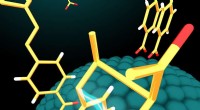
* Use 3D models and animations to represent the reaction process at the atomic and molecular level. These can help visualize the movement of atoms, the breaking and forming of bonds, and the energy changes involved.
* Benefits: Provides a more intuitive and engaging understanding of the reaction.
Ultimately, the "story" of a chemical reaction is told by combining information from these different sources. The more information you gather, the more complete and nuanced your understanding will be.