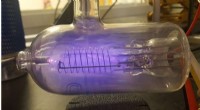
* Balmer series and electronic transitions: The Balmer series corresponds to electronic transitions in an atom where the electron moves from higher energy levels to the second energy level (n=2). This transition results in the emission of light in the visible region of the electromagnetic spectrum.
* Hydrogen's simplicity: Hydrogen has only one electron and one proton, making its electronic structure very simple. This simplicity results in well-defined energy levels and a very prominent Balmer series.
* Other atoms: In other atoms with multiple electrons, the electronic structure is more complex. The energy levels are affected by electron-electron interactions, making the transitions less clear-cut. As a result, the Balmer series in other atoms is weaker and less distinct.
* Similar series in other atoms: While the Balmer series is specific to transitions to the second energy level, other series exist for transitions to different energy levels. These series are named after their discoverers, like the Lyman series (transitions to n=1) and the Paschen series (transitions to n=3).
Therefore, while the Balmer series is most prominent in hydrogen, it can be observed in other atoms as well, albeit with varying degrees of prominence.