Here are some examples:
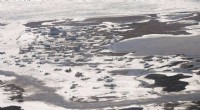
* Ice (solid water) is less dense than liquid water. This is why ice floats. The molecules in ice are arranged in a crystal lattice structure that has more empty space than the more tightly packed molecules in liquid water.
* Some metals, like lithium and sodium, are less dense than water. This is because they have a relatively low atomic mass and a loosely packed crystal structure.
* Aerogels are extremely porous solids that can be incredibly lightweight. They are made up of a network of extremely fine, interconnected pores filled with air. This makes them very low density, often less than air itself.
So, while solids are generally considered denser than liquids, there are exceptions to this rule. Density is determined by the arrangement of molecules and the amount of space between them, and these factors can vary greatly between substances, even between the solid and liquid states of the same substance.