Explanation:
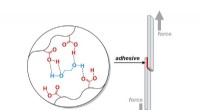
* Hydrogen bonding: Water molecules are capable of forming hydrogen bonds, which are strong intermolecular forces. Oxygen is highly electronegative, creating a partial negative charge on the oxygen atom and partial positive charges on the hydrogen atoms. This allows water molecules to form strong dipole-dipole interactions and hydrogen bonds.
* Methane (CH4): Methane molecules are nonpolar and only exhibit weak London dispersion forces, which are the weakest type of intermolecular force.
Therefore, the stronger hydrogen bonding in water leads to a significantly higher force of attraction between its molecules compared to the weak London dispersion forces in methane.
Key Points:
* Stronger intermolecular forces result in higher boiling points, melting points, and surface tension.
* Water has a higher boiling point (100°C) than methane (-161°C), reflecting the stronger forces of attraction between water molecules.